
Software
Software solutions
Fifteen years of factory automation software: the control code that runs a machine, the systems that move material across a factory, and the AI that inspects what comes off the line. Delivered on a standardized framework the customer can maintain themselves.
Equipment control
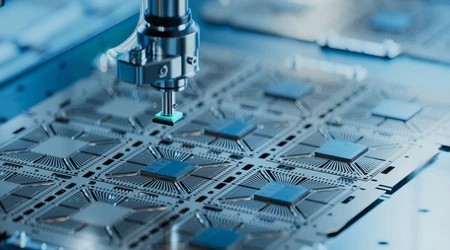
We develop and deliver PC-based control software for whatever equipment a customer needs to run. Our control framework is the product of 15 years of field experience, including high-precision die bonders — widely considered the most demanding machines in semiconductor manufacturing.
Strengths
- 01
Because everything is built on our own standardized machine control framework, the customer who takes delivery of the software can maintain it themselves. Even if the engineer responsible leaves, a replacement can pick the work up after training on the Hotbee framework.
- 02
The framework itself is customer-modifiable, so it never becomes a constraint on what you can build.
- 03
Devices such as motion controllers and I/O boards are modularized so they can be swapped easily, letting you choose whatever makes sense given component availability.
Development history
- LED die bonders, 400 units (Samsung, high-speed, 20k UPH)
- 24-lane test handlers, 200 units (Samsung, high-speed, 18k UPH)
- Chip mounters, 100 units (dual gantry, 6 heads each, 5 µm precision, Samsung)
- 3D laser printers
- Ceramic screen printers
- Laser CAD/CAM
ControlBee — an open-source framework for manufacturing equipment control
ControlBee is the first open-source machine control platform of its kind, built by Hotbee for equipment control across semiconductor, secondary battery, and solar manufacturing. Written in C#/.NET, it targets industrial equipment software that needs deterministic, sequential control logic — pick-and-place, assembly lines, and semiconductor, battery, and solar equipment. It provides a unified, type-safe API over the hardware equipment normally depends on — motion axes, digital and analog I/O, sensors — so the same control logic works regardless of hardware vendor.
Core concepts
- Actor
- The central unit of control logic, based on the actor pattern popularized by Akka. Each actor processes mailbox messages one at a time on its own thread and manages state as a stack that supports nesting. Typically one actor owns one physical machine or subsystem.
- Devices
- A minimal-dependency hardware abstraction layer — motion controllers, digital and analog I/O — implemented by hardware vendors and system integrators.
- Control primitives
- Higher-level building blocks on top of devices: IAxis motion control (software limits, homing, absolute/relative/velocity moves), digital and analog I/O, IBinaryActuator, and others.
- Variables
- Type-safe state held in a built-in SQLite-backed store that persists across sessions — multi-axis coordinates (Position1D through Position4D), motion parameters such as SpeedProfile, and more.
- Dialogs
- A UI-framework-independent way to request operator input on a sensor timeout or an alarm.
ControlBee turns control code that used to be rewritten from scratch for every machine into reusable, standardized components. It is released under the MIT license, so anyone is free to adopt, modify, and redistribute it. Hotbee supports the full arc on top of ControlBee: new equipment development, legacy system modernization, and building an in-house control platform.
Logistics automation
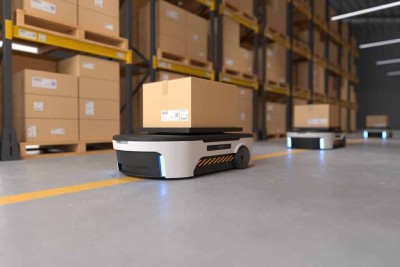
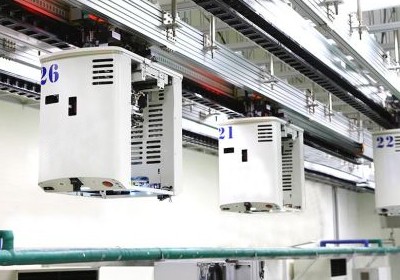
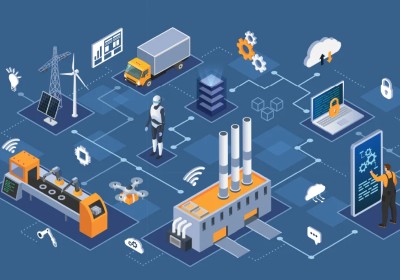
We deliver the whole stack, from the vehicles themselves through to the factory software that coordinates them. Available as software alone, or with hardware built to your specification.
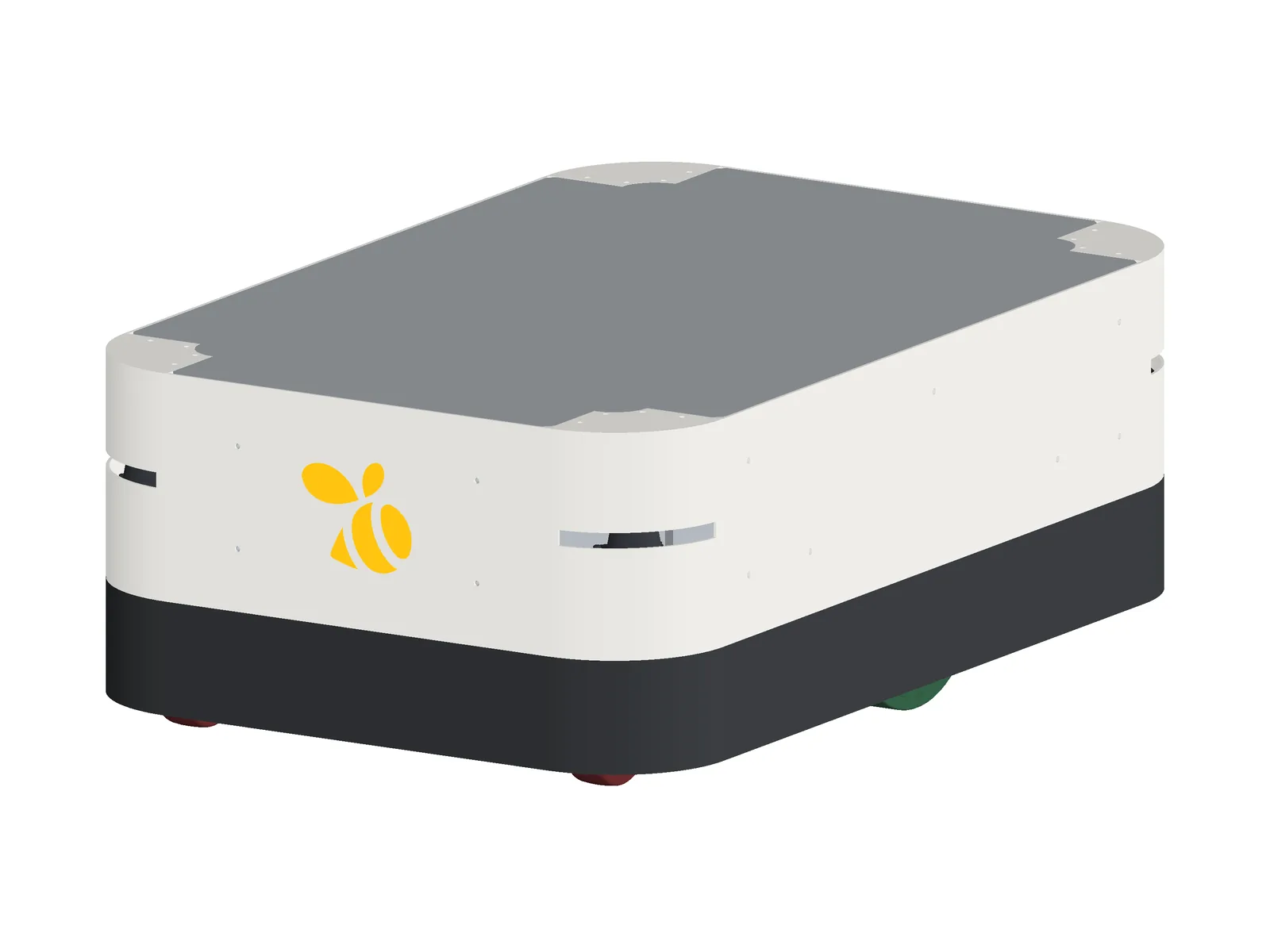
- AGV (Automated Guided Vehicle)
- Reliable line-following vehicles, proven at scale with over 400 units delivered to Samsung. Line following is AI vision-based, which minimizes errors caused by damaged guide lines.
- AMR (Autonomous Mobile Robot)
- Sensor fusion combines landmark, line, vision, and sky guide sensors, so vehicles run reliably even in environments where SLAM alone struggles.
- ACS (AGV/AMR Control System, Fleet Management System)
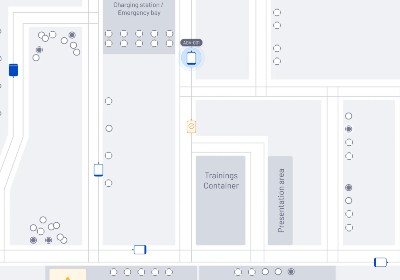
- Plans and manages routes so that dozens of AGVs move in an orderly way without deadlocking, even on single-lane paths. Its strength is a route prediction algorithm that accounts for estimated time of arrival, minimizing unnecessary stopping and waiting.
- OHT / OCS (OHT Control System)
- Manages OHT routing, similar to ACS. Because OCS networks are mostly one-way where ACS networks carry a lot of two-way traffic, OCS is the less complex of the two.
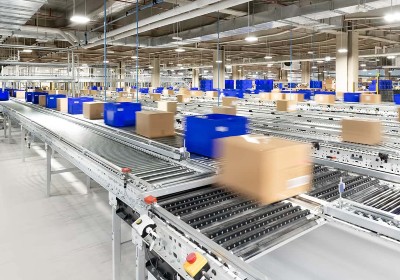
- Conveyor / CCS (Conveyor Control System)
- Manages conveyor-based material flow. Less complex again than OCS.
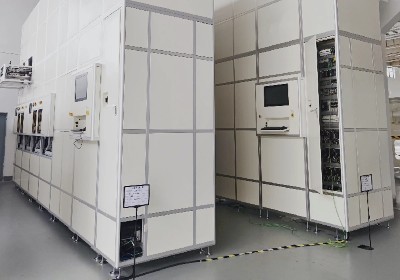
- SCS (Stocker Control System)
- Controls the stockers that hold material, storing and retrieving it quickly across stockers built from hundreds or thousands of cells. An optimization algorithm frees space by moving material to temporary storage when a location runs short. A dual backup system means a material location is never lost.
- MCS (Material Control System)
- Controls material transfer across the factory, issuing commands to transfer modules — AGV/AMR, OHT, stocker, conveyor — to move material where it needs to go. Where several transfer routes are possible, it selects the best one.
- APS (Advanced Planning and Scheduling)
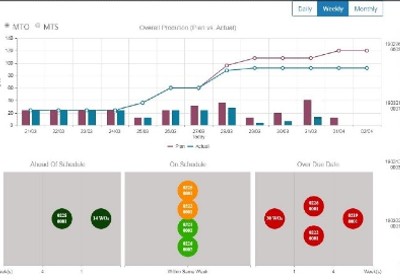
- Takes the customer shipment plan set in MES and works out specifically when and how much the factory needs to produce. Execution of that plan happens in RTD.
- RTD (Real-Time Dispatcher)
- Decides in real time which material should be moved right now, based on the production plan produced by APS, and hands the resulting transfer orders to MCS.
- EAP (Equipment Automation Program)
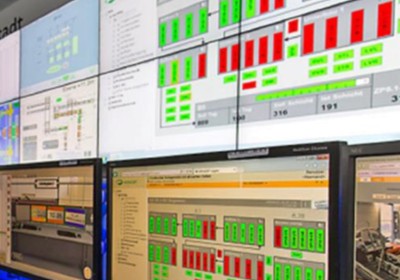
- Communicates with equipment across the factory to control and monitor each machine. That information is passed on to MES or RTD for use elsewhere.
- MES (Manufacturing Execution System)
- Everything the operator running manufacturing needs, in one system. It integrates with ERP to set customer shipment schedules as the target and to track whether the factory is actually running to them.
AI machine vision
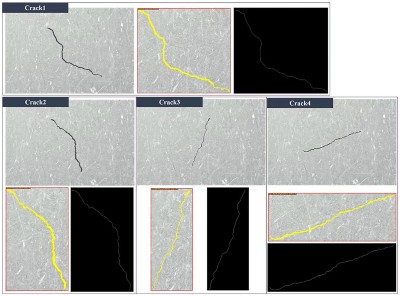
We build AI defect inspection systems. Our strength is data augmentation using deepfake techniques: where defect samples are hard to come by, we can synthesize enough data to train on. Manufacturing produces plenty of good units and few defective ones, which means an AI model tends to miss each new defect type the first time it appears — that is the problem we solve.
Project history
2026
- Smartphone camera module (optical image stabilization, OIS) 2D / 3D inspection systems
- KUKA AMR-based ACS (AMR Control System)
- Automotive pressure sensor die bonder and EOL tester
- SAW package test handler and vision inspection system
2025
- MLCC auto trimming machine
- Secondary battery electrode winder
- Automotive pressure sensor module inserter, housing welder, and characteristic tester
- Smartphone camera module (OIS) spring and housing assembly machine
- Conformal coating dispenser
- Dispenser CAD/CAM software
Key customers
- Samsung Electronics
- Samsung Electro-Mechanics
- Hyundai Motor
- Amkor Technology
- WISOL
- JStech